Showing posts with label thermometer. Show all posts

Monday, 26 October 2015

Cawenlon Rectangular Compass & Thermometer Watch

Keeping in with the watch theme from the end of last week, I have another gadgety fashion watch to blog today.

This watch is by Cawenlon, who are a fashion brand making several different watch designs, but without an obvious homepage online. I've seen several watches of theirs online (although a lot are listed as Cawelon), and most have the same features, just in a different layout.

This model comes with a large rectangular case (5.5 cm wide by 4 cm tall) and 3 displays on the front. The right display is a standard 3 hand dial quartz analogue watch display with a curly C logo below the 12. The left hand display is a round thermometer dial with a needle pointing to the right temperature (in Celsius). At the top in the middle of the face is a smaller display, and this is a small compass floating in a bubble of liquid, and at the bottom middle is the Cawenlon brand name.

There is no information on the watch which allows me to search the history, so I don't know much more about it (except that the back is stainless steel). My guess is that it is reasonably new (early 2010s, possibly a little earlier), and it looks to be a low cost brand.

Friday, 23 October 2015

Cosmo Queen Flip-Top Compass Watch

One of the key starting points for my collection was the idea of "interesting and unusual". The collection has expanded beyond this, but I still have a thing for unknown gadgety watches like today's.

This watch seems to be called Cosmo Queen, based on how I've interpreted the hard-to-read script that the name is written in. I've found two main references to the name Cosmo Queen - one is a card from Yu-Gi-Oh! while the other is a range of watches by a Swiss brand called Titoni. I'm pretty sure this has nothing to do with Yu-Gi-Oh, and based on the design, I don't think it is by Titoni either, so it must be one of the unknown fashion watches.

The watch is a standard 3 hand dial design with a Japanese quartz movement. The difference is that you can flip the lid up to reveal a compass underneath, and when you do, you can also Flip the watch part over so you can see the time and compass together. The strap also has another feature - there is a round thermometer set into the lower part of the strap.

I don't know much more about the watch (as the back of the case only says Swiss Army, but I think that is only used as a name rather than a reference to who commissioned it). This type of watch has been around since at least the 90s, so it could be from anytime since then.

Sunday, 5 April 2015

Alba Hyper-Tech Carbon Twin Sensor

As it's Easter Sunday, it's a tradition to go for a hike before sunrise and watch the sun come up from the top of a hill. For that purpose I decided to wear a watch designed for the hills.

The watch I chose today is by the Seiko brand Alba, and part of their Hyper-Tech (or Hypertech) range. The watch has many names printed on it: Carbon, Twin Sensor, and Alti-Thermo.  I think that Carbon refers to a particular line of Hyper-Tech watches, while the twin sensor and alti-thermo names refer to the fact that this watch has both barometer (altimeter) and thermometer sensors /functions. The design is big and chunky and has a look which is a little reminiscent of the G-Shocks, but with a non-symmetrical shape. There are many screws on the case, and the sensor is visible at the top of the watch. The strap is a rubbery plastic (which suffers from brittleness) with a ridged design and had the part number of PW031.

The LCD is split into two sections for the different features. The top display has a dot matrix array and a small area for digits, and is used for the day and date as well as the altitude graph or elevation change and hundredths of a second in stopwatch mode. The bottom part of the LCD has two lines which give the time (6 digits at the bottom) and height and atmospheric pressure above. At the right side of this section is a set of Arrows pointing up and down to indicate the change in atmospheric pressure and hence predict the weather (going up =sun, and going down =rain). The watch is controlled by 5 buttons for the modes, adjustment, start/stop and light (small bulb based). The mode button unusually pulls out to put the watch in time setting mode.

The watch is powered by a W754 module which has alarm (possibly time, altitude, and temperature), altimeter /barometer, and chronograph (with altitude recording).

This model is the W754-4A00 and came out in 1995. The catalogue number was ADQP001 and an original sales price of ¥14,000.

Tuesday, 22 April 2014

Storm Navigator

Today's watch is one that I've been wanting since I'd first started collecting watches, but I'd not been able to afford it then while I was a student, and then it wasn't for sale anymore.

The watch is by the London based brand Storm and is called the Navigator.

The Storm brand began at the end of the 80s and have been producing many different interesting designs of watches.

The Storm Navigator was released in the mid 90s, and was one of the most high tech watches they produced at the time. The watch is large and pretty thick and the face shows 4 circular windows. It seems that the design was reissued, starting in 2009, and is currently for sale on the Storm website.

The Navigator has quite a few functions, and includes both analogue and digital time display with a 2 hand dial and a small LCD display with two rows of two digits (placed at the diagonals). It also has windows for an analogue thermometer, and a small compass. On the bottom section of the watch is an orange torch which lights for a few seconds after pressing the button.

Inside, all of the parts are in separate modules. Opening the back first reveals the torch module, and that needs to be removed to get to the rest of the modules. The thermometer and compass are small independent removable modules, and the two watch modules are also in separate slots. The analogue module is a standard Japanese quartz module, and the LCD module is a tiny unit, less than 1cm x 1cm and around 5mm thick.

Sunday, 20 April 2014

Casio Protrek PRT-40 Bird Life International

I decided on today's watch as it is Easter Sunday, and that is a day I go hiking up a hill to watch the sun rise.

The watch I chose is one of my more extreme outdoor watches, and was also a milestone when it came out.

The watch in question is part of the Casio Protrek range and is called the PRT-40. It came out in Japan in 1996 and was the third of the Protrek Triple Sensor watches. On the European Casio site, the PRT-40 is shown as one of the watches in their milestone list with a 1998 release date, so I think it was just late coming out of Japan. As this was a Japanese release, and the module date starts in 1995, i think this was an early PTR-40 model.

The Protrek range started in 1994 as an outdoor watch range for hikers. They started with a triple sensor watch which evolved very little design wise to the PRT-40, but this model was the first with an automatic el-backlight.

This particular version is the PRT-40BLJ, and is a model that as released in partnership with BirdLife International. The BirdLife International organisation is a global collaboration between different conservation organisations. It was started in 1922 as the International Committee for Bird Protection, but changed its name in 1993. The organisation is in charge of the official Red List of birds requiring protection.

The PRT-40 is a typical triple sensor model with thermometer, compass, and barometer/altimeter. It has a large and robust design with a round LCD display in the centre. The LCD display is made up of three rows and a display round the edge of 60 markers for seconds or as a part of the compass. The other parts of the LCD are the time at the bottom, date or temperature /height in the middle, and a small dot matrix at the top (for day or mode).

Inside is a 1471 module which is powered by 2 batteries. Modes on the watch include altitude /temperature (with altitude graph on the dot matrix), data recall (for heights and temperatures), alarm (x5), and stopwatch. The compass is not accessed through the mode button, but the bearing button. Pressing this shows the current bearing, but it is not a live compass, so doesn't change automatically when you turn.

The strap is a fabric, leather, and cord design, fastened to the case through Protrek branded plastic connection, which also has the BirdLife International name printed on it. The first part of the strap is the black leather section, imprinted with the Protrek logo, which is sewn to the velcro fabric strap. It also connects to the secondary cord fastening with a Protrek branded hook, which makes sure that the watch can't accidently fall off.

The back contains the usual information, and has a BirdLife International logo dominating the back plate.

Tuesday, 18 March 2014

Alba Twin Sensor W750

After a few newer watches, I'm taking it back to the 90s with today's watch.

The watch is one of the Twin Sensor range of watches by the Seiko brand Alba. The watches were released in the 90s to be high tech watches for outdoor use, with sensors designed to help with your outdoor activities.

This model is the W750 and comes from 1995. It is a smaller design than some of the Twin Sensor designs, but still has a barometer /altimeter, and a thermometer.

The LCD display is quite packed with 3 lines of information. Along the top is the altitude and barometric pressure display and the bottom line covers the time. The middle line has a dot matrix array and additional digits which normally shows the date and day. The dot matrix can also show a graph of your altitude over time as well as some text. As well as these, there is a set to do markers down the right side of the watch which show the trend of air pressure, and uses that to predict the weather.

The modes I'm this model are aimed at climbing and hiking. As well as the altimeter and barometer and temperature sensor, the watch has a memory recall (for altitude), alarm, and an Alti-Chr. The Alti-Chr is like a stopwatch, but it also measures your altitude and rate of climb, and is controlled by the front button. As needed for an outdoor watch, it is also 10 bar water resistant. The time adjust is unusual on this model in that you pull out the mode button to activate.

The full model number is W750-4A00. It has an Alba strap with the part number FA89FE 20. The catalogue number was ADQB003, and it originally sold  ¥14,000.

Tuesday, 18 February 2014

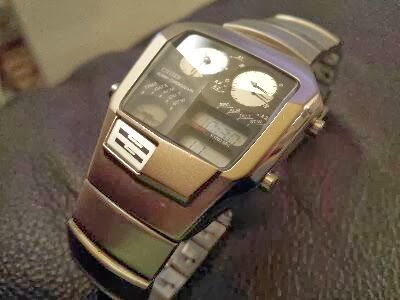
Citizen Ana-Digi Temp 8988 angled design

I'm blogging another from my Ana-Digi Temp collection today, and this one has a different look than the normal design.

The Ana-Digi Temp range by Citizen started in 1982 and were the first range of electronic temperature measuring watches. I have am Ana-Digi Temp overview page where I go through more of the details (link to the top right on the web version and from the drop down menu at the top on the mobile version of the site).

This Ana-Digi Temp has an unusual design compared to the rounded rectangular design that the majority have. The case has a tapered shape and is wider at the top than the bottom. The temperature sensor area is also more angular and follows the shape as the watch tapers down to the matching strap.  The glass in this model is also shaped to have 3 different faces, raising to the highest point where they meet in the middle of the watch. Strangely, it doesn't have the Ana-Digi Temp name on the watch, and just says Alarm Chronograph. Based on the serial number, this design is from 2003.

This version uses the 8988 module which is one of the standard inside for an Ana-digi Temp. It has the 2 electronic dials at the top of the face with 3 LCD windows below. The watch has dual time, alarm, stopwatch, and of course temperature modes, and my overview page explains how those are displayed between the different dials and LCD panels.

The full model number is 8988-Q02047 and I think this had a catalogue number of JG2040-54A. There is also a small number at the bottom of the face which reads S04-M530. I've seen from one online site that it had a price of ¥13,450.

Thursday, 16 January 2014

Citizen Trans Continents Ana-Digi Temp 8989

As you'll probably have noticed, I'm a fan of the Citizen Ana-Digi Temp watches. Citizen first released these in 1982, and have been releasing models in many of their different ranges.

Today's model is from a range I've blogged much about before as well. This is the Trans Continents version, and uses the 8989 module which has been used in most of the more modern models. Full details on the Ana-Digi Temp range can be found in my summary page.

The Trans Continents range are a set of watches by Citizen that were released for the Japanese clothing brand Trans Continents and don't appear in the regular Citizen catalogues.

The layout of the face is the standard arrangement for an 8989 module watch, but this has the Trans Continents name below the A1 dial, and the details of the button functions are all along the right side of the face. The case shape is different for this model, being more square than most others, and without the normal panel in the bottom left where the temperature sensor lies. It is a light watch with the case being made from Aluminium.

It has 2 dials and several LCD display windows, and the details about what shows where is all in my summary page.

For the modes, it has dual time, alarm, chronograph, and of course temperature readings.

The full model number is 8989-S010781, and it comes from 1993 or 2003 (and i would guess 2003 is more likely).

Friday, 20 December 2013

Aquatech Ana-Digi watch with Compass and Thermometer

I've always had a liking for watches with temperature sensors, but this one is a little different than the normal.

This watch is by Aquatech, who are a slightly mysterious company who seem to have made all manner of different designs of LCD watches.

This model is an Ana-digi design with a 3 hand dial and 3 small round LCD, windows. The watch also has a compass and a thermometer but these are strange as they are mounted on the strap. The thermometer is a dial type with readings in both Celsius and Fahrenheit. The compass has a floating magnet in its housing.

At the moment, the LCD display doesn't work. Looking at the buttons, it has at last a stopwatch mode, and there is a buzzer so I'd assume there is an alarm. There is also a light button.

It may just be a flat battery as the back states there is an SR626SW(AG4) and a CR2016, but I only found the AG4 and an AG3, but no sign of the CR2016 when I took the watch apart.

The only other information I have is that it is 50m water resistant and made in China.

Saturday, 7 December 2013

Timex Skiathlom with pink elastic strap

I've picked my watch based on weather again. It's really snowy today so I decided to blog the 3rd of my Skiathlom watch variations by Timex.

In previous posts I mentioned that there were two colour schemes for the head, and two styles of strap. I've now concluded that each watch came with both a resin and an elastic strap (as this one came with both), and each watch colour had a different colour elasticated strap (-i don't know about the resin one yet).

So, this one is the light blue and purple variation, and it came with a bright pink elasticated strap with the Timex name on. This elasticated strap also has a plastic clip fastening (that the blue strap didn't).

The Skiathlom was one of three different sports watches based around the same module. The Skiathlom was the skiing watch, the K-28 Surf was for water sports, and the Hooks was for fishermen (with all 3 to be found on this blog).

The design has a two line LCD with time on the bottom and day and date at the top. The watch has a temperature sensor (with a bar readout at the top of the LCD), timer, and chronograph modes, and the start and stop buttons are large enough to use with gloves.

It originally came out in 1987 and cost ¥14,500.

Thursday, 5 December 2013

Suunto Vector Black

We're expecting a storm to pass here over the next couple of days, so I decided to choose a watch that can survive the elements.

The watch I chose was the Vector black by Suunto. The Finnish company Suunto Oy was created in 1936 and are manufacturers of outdoor watches, dive computers, and compasses. The factory is next to the headquarters in Finland, and many of the watches are still hand finished.

The Vector model is called the original outdoor watch on the Suunto website, and is one of the most popular models. It is a compass and barometer watch, and uses the air pressure change for altitude calculations. The watch case is quite large and ruggedly built with a custom strap. The front us dominated by the large round LCD display. Time is shown on the largest digits in the centre, and the seconds are shown in a ring around the edge of the dial, or they can replace the date on the bottom. In the top left is a little barometer sign showing the air pressure trend. The compass mode shows the North using the markings around the edge, along with your bearing in digits at the centre. There is also a little spirit level bubble on the glass to make sure it is flat. The altimeter shows height in meters, and has a rate of climb/descent at the top of the display. You can change this to show air pressure in millibar, and in this display, it also shows the temperature. The other watch modes are alarm (multiple), stopwatch, and timer. It takes a very large, and not so common battery, the CR2450, which is accesses with a coin opening slot on the back. My one has had a bit of a hard time in the past so has lost its printing around the face.

This model has been popular in the movies and on TV, appearing in the movie Shooter, the TV series Supernatural, and being the main prop on the film Clockstoppers.

Sunday, 31 March 2013

Timex Expedition WS4

An Easter Sunday tradition on a nearby island is to watch the sun rise from the highest point on the island, and hope to see the sun dance. So I decided today should be one of my hiking watches.

The chosen watch is by the Timex watch brand, and part of their Expedition line of watches.

It has probably the most comprehensive LCD display of any of my watches, having a dot matrix area (for time and mode description), two areas for numbers (both of which are also set-up to do letters), an LCD dial display, and a part with pictures of weather conditions.

The weather conditions icons are from the barometer part of the watch, as the changes in pressure can be used to predict the weather, and this is shown on the watch. Below the icons usually lies the temperature of the watch - but as with most watch thermometers, it's badly affected by body temperature. The pressure sensor is also used for the altimeter, and the watch can show graphs of a walk, store data on a journey, have alarms at a set altitude, or just your altitude on the display.

The last hiking function is the compass, which I think is gyroscope based rather than magnetic (as you have to calibrate north). On this mode, the LCD dial points as a compass, and it also shows heading in text and degrees. The LCD dial usually shows the time, but the number of LCD segments can only show changes of two minutes.

There are still even more functions in the watch. It also has a chronograph, timer, dual time, and alarm!

The model number is WS4, and on the back there are two numbers - M810, and the serial number. I guess the WS stands for Wide Screen, as the watch is known for it's widescreen dashboard display.

It is a well sealed watch (50m water resistant), but has a battery hatch on the back. It takes a CR2430 battery, and is the first watch I've come across with that big battery - 24mm by 3mm deep.
The model originally came out in 2009, but is still available today at a cost of around $120-150 (although it seems that this colour is no longer available). The instruction manual pdf can be found at the Timex website.